How does barefoot podiatry benefit your foot health?

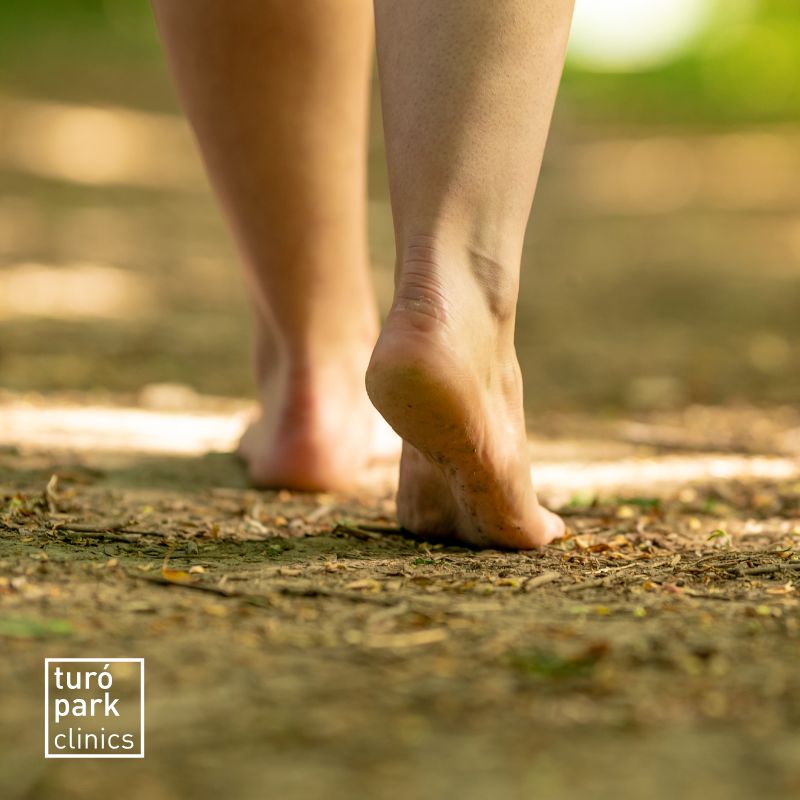
Traditional footwear often acts as a rigid splint. Narrow toe boxes cramp the toes, while air cushions and heels numb the nerves and weaken the muscles of the sole. The barefoot or minimalist footwear approach advocates for the exact opposite: restoring the foot's natural freedom through thin, flexible, and completely flat soles that allow the toes to splay and regain balance.

However, your feet have spent a lifetime accustomed to being highly protected. Switching from your regular shoes to minimalist ones overnight, and immediately walking on hard city asphalt, often results in muscle strain or pain due to a lack of conditioning.

We help you prepare and strengthen your bone and muscular structure so you can enjoy a safe, healthy, and pain-free transition to barefoot footwear.

3D gait analysis and barefoot podiatry in Barcelona

Barefoot Podiatry Unit: Key Facts

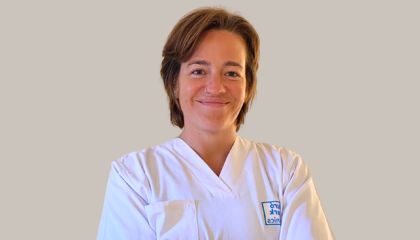
  • Medical Leadership: Headed by our podiatrist specializing in clinical biomechanics, Isabela Iribertegui.
  • Specialized Diagnosis: High-precision digital 3D Gait Analysis.
  • Clinical Programs: Guided, safe, and pain-free transition to barefoot and minimalist footwear for adults.
  • Biomechanical Support: Custom-designed 3D-printed flexible insoles for functional foot re-education.
  • Premium International Service: Private medical center in downtown Barcelona providing bilingual care (🇪🇸 🇬🇧) with no waiting lists.

Discover the barefoot approach

#what-is-it

What is barefoot or minimalist footwear, and how does it affect foot anatomy?

Barefoot footwear is fundamentally designed to interfere as little as possible with the foot's natural movement, emulating the mechanical conditions of walking completely barefoot. For a shoe to be clinically considered respectful of human anatomy, it must strictly meet four structural properties:

  • Wide anatomical toe box: Provides ample space for the toes to splay naturally, improving grip and stability while walking.
  • Zero drop: The heel and the forefoot are at the exact same height. With no heel elevation, body weight is distributed more evenly, preventing tension in the calves and the Achilles tendon.
  • Thin and flexible sole: Allows the foot to bend freely in any direction and enables the sole to "feel" the ground, actively stimulating balance.
  • No rigid supports: It excludes stiff counters in the heel or artificial arch supports, forcing your foot muscles to work and strengthen on their own.
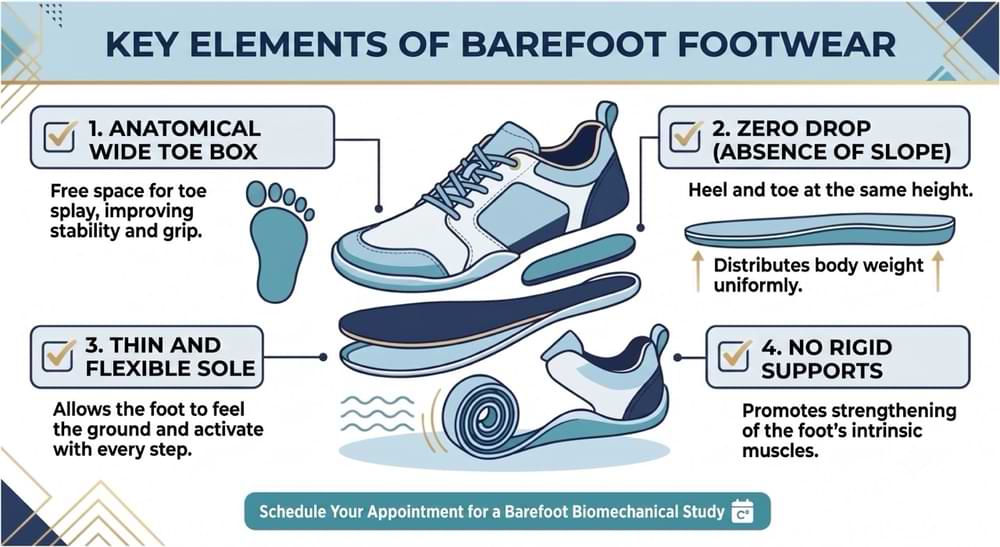
Key features of barefoot footwear anatomy
#benefits

Benefits of barefoot and minimalist footwear

Wearing this type of footwear daily helps strengthen the intrinsic muscles of the foot. When transitioning to minimalist shoes as an adult, the stimulation of the sole triggers two major improvements throughout the body:

Postural stabilization and functional balance

Thanks to the thin sole, the thousands of nerve endings in the foot can better feel the ground. This sends rapid feedback to the brain, optimizing your automatic postural reflexes and overall stability.

→ Articular load redistribution

By eliminating the heel elevator, the body regains its natural alignment and weight is distributed more evenly. This reduces stress on the knees and decreases chronic strain in the lumbar region.

Educational Outreach

Isabela Iribertegui on Jorge Verdú's "EL TROZO" Podcast

Scientific dissemination is essential for a safe transition. Recently, Isabela Iribertegui participated in a podcast interview where she thoroughly analyzes foot re-education and the health benefits of barefoot footwear.

  • Gait pattern: Key insights to identify a physiologically healthy stride.
  • Injury prevention: How to avoid common pathologies such as Morton's Neuroma.
  • Active Barefoot: Adapting minimalist footwear to trail running and hiking.
  • Science of Grounding: The real clinical impact of walking barefoot on neuromuscular connection.

Want to learn more? Listen to the full interview below:

#contraindications

When is minimalist footwear not recommended? Clinical contraindications

While freeing the foot is highly beneficial, it is not always the immediate solution for everyone. Foot pain from barefoot shoes usually occurs when there are underlying pathologies or when the body's structural limits are pushed too quickly. The primary situations where minimalist footwear is discouraged (or requires a prior evaluation with our podiatrist specializing in barefoot footwear) include:

1. Diabetic foot or peripheral neuropathy
As the patient loses their sense of touch, they are unable to detect friction or minor injuries. A sole this thin increases the risk of developing pressure ulcers.
2. Severe osteoarthritis and joint stiffness
In joints with advanced wear and tear, excessive mobility causes bone-on-bone friction and pain. In such cases, soles with a certain degree of protective rigidity are beneficial.
3. Rigid structural deformities
Severe flat feet with complete collapse of the arch lack natural cushioning. Without elastic support, chronic tendinitis can develop as a result of overstretching.
4. Severe muscle shortening
People who have worn high heels for decades experience stiffness in their calves or soleus muscles. Switching straight to flat soles creates dangerous tensile stress on the Achilles tendon.
Barcelona Specialists · 15+ Years of Experience

Healthy feet are the foundation of everything.

Our podiatrists, specialised in biomechanics and barefoot footwear, help you improve your posture, relieve pain and move better from your very first visit.

  • Personalised biomechanical assessment
  • First appointment with no waiting list
  • Ongoing treatment follow-up
Book now

No obligation · Instant email confirmation
Barefoot podiatry specialists and biomechanical gait analysis in Barcelona - Turó Park Clinics
#how-to-choose

How to choose your first pair of barefoot shoes? Medical selection criteria

The current market offers a wide variety of options, which can be confusing. From a clinical perspective, the podiatry team at Turó Park Clinics advises against searching for a specific brand; instead, you should verify that the structure of the shoe strictly adapts to the biomechanical requirements of your feet during the transition period:

1

Transition footwear vs. Pure barefoot shoes

Adaptive step: Avoid overloading the Achilles tendon and plantar fascia.

If you have worn conventional footwear with an elevated heel or a high drop your entire life, making a drastic switch to an ultra-thin sole (3 to 4 mm) on the hard asphalt of Barcelona can trigger plantar fasciitis or Achilles tendonitis due to mechanical stress. Clinically, we prescribe starting with transition shoes: models that feature the anatomically wide toe box and a flat (zero-drop) sole, but maintain an intermediate cushioning thickness so that your musculoskeletal tissue can adapt without suffering microtrauma.

2

The correct biomechanical fit

Functional expansion margin: Calculating the free digital space.

Barefoot footwear should strictly measure between 8 and 12 millimeters longer than the actual length of your foot. This extra space is not a matter of aesthetic preference, but a biomechanical necessity: during the push-off and weight-bearing phases of your gait, the foot naturally flattens and expands. Guaranteeing this clearance directly prevents severe compression pathologies such as Morton's Neuroma, ingrown toenails (onychocryptosis), and claw toe deformities.

3

The securement and fastening system

Active support vs. Reflexive midfoot instability.

For the intrinsic muscles to work physiologically, the footwear must feature an effective adjustable securement system (adjustable laces or straps) that holds the instep firmly in place. If the shoe is not properly secured to the midfoot, the toes execute an unconscious "clawing" reflex to prevent the shoe from slipping off. This alters your gait pattern, creates harmful strain on the fascia, and causes hyperkeratosis (calluses) due to reactive friction.

4

Torsional flexibility and proprioception

Neuromuscular stimulus and freedom across three spatial planes.

The sole of the shoe must not only be thin, but it must also allow for complete torsion and helicoidal rotation of the foot. Pliable footwear ensures that the midfoot joints (such as Chopart's and Lisfranc's joints) can execute the natural pronation and supination needed for shock absorption. Furthermore, this closeness to the ground optimizes the stimulation of the sole's mechanoreceptors, enhancing automatic postural reflexes and dynamic balance in urban environments.

5

Three-dimensional morphology and instep

Assessment of foot volume and toe-box shape profile.

Selecting the ideal model requires assessing the foot beyond its length in centimeters. It is crucial to analyze the toe profile (the longitudinal distribution of the toes: Egyptian, Greek, or Roman) and the height of the instep. Footwear with insufficient dorsal volume will compress the extensor tendons against the shoe upper, restricting local blood flow and limiting the natural elasticity of the plantar arch during gait impacts.

#gait-analysis

The role of gait analysis in a safe barefoot transition

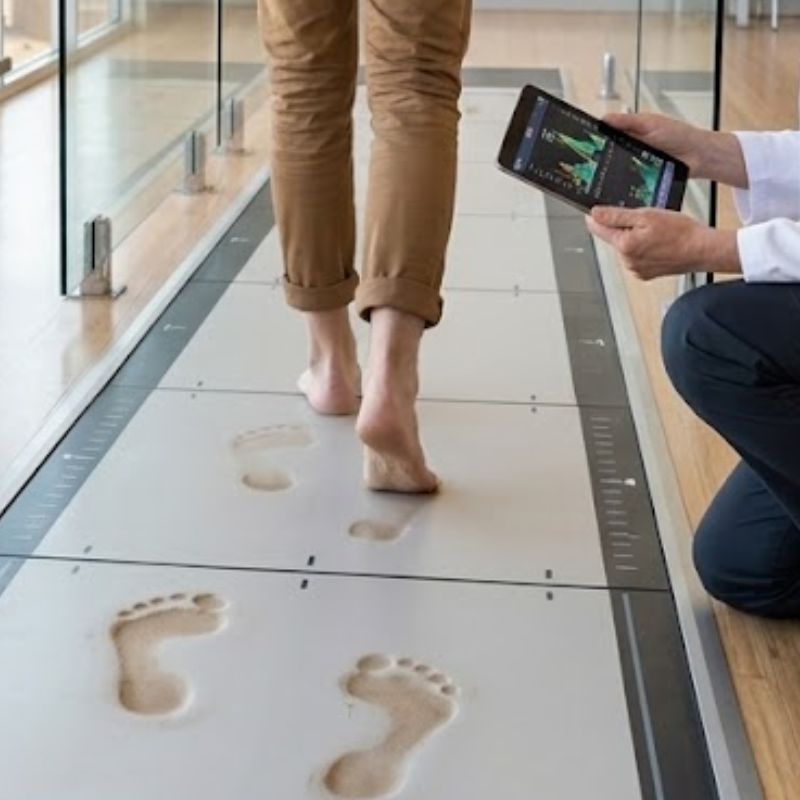
To prevent injuries, a clinical gait analysis is your best preventative tool. In our clinic, we utilize digital platforms and 3D technology to analyze your stride in motion and pinpoint the areas of peak pressure while walking.

With this biomechanical roadmap, we assess whether your feet are ready for minimalist shoes or if they require pre-conditioning. Furthermore, if imbalances are detected, this barefoot biomechanical assessment allows us to design 3D-printed flexible insoles—dynamic guides that support the foot while it strengthens to guarantee a safe transition. To learn more, check out our section on biomechanical gait analysis.

Biomechanical Study of Barefoot Gait in Barcelona
#faq

Our answers to frequently asked questions about barefoot or minimalist footwear

Is barefoot footwear good according to podiatrists?

Yes, as long as the transition is gradual and supervised. By strengthening the intrinsic foot muscles and improving proprioception, it offers real benefits. The risk isn't in the footwear itself, but in switching abruptly to an unprepared foot, which can cause plantar fasciitis or overload injuries.

How long does the transition to respectful footwear take?

Typically between 3 and 6 months, though it varies by individual foot. We recommend starting with 30–60 minutes per day and gradually increasing usage. A prior biomechanical assessment allows us to personalise this pace and prevent injuries from adapting muscles too quickly.

Who shouldn't wear barefoot trainers?

We need to assess carefully cases of diabetic foot, neuropathies, advanced osteoarthritis or rigid structural deformities. In these profiles, the lack of cushioning and protection can be counterproductive, so a podiatric evaluation is essential before making the switch.

Does minimalist footwear make feet grow larger?

It doesn't alter bone length, but it does widen the foot naturally. After months of use, many adults need a larger size because their toes expand laterally when released from compression and the arch recovers its elasticity.

Which sports allow barefoot trainers?

They're ideal for linear or highly stable activities: running, light trail running, hiking and strength training at the gym, where a flat base optimises force transmission.
#our-team

Our barefoot specialist at Turó Park Clinics

Isabela Iribertegui - Podóloga Turó Park Clinics
Written and Reviewed by

Isabela Iribertegui

Specialist in Clinical Podiatry, Surgery, and Biomechanics

A podiatrist specializing in clinical biomechanics and functional rehabilitation at Turó Park Clinics (Barcelona). With extensive experience in minimally invasive foot surgery and in designing transition programs to minimalist footwear, she combines daily clinical practice with ongoing training in sports podiatry and regenerative medicine. Her approach integrates the latest scientific evidence with a patient-centered perspective, always seeking both short- and long-term solutions.

Take a look at the financing options

Don’t worry, we’ll take care of everything!