Regain your mobility with advanced foot surgery
Foot pain and conditions significantly affect mobility and quality of life, which is why at Turó Park Clinics we approach each case through a personalised clinical assessment carried out by our team of podiatrists in Barcelona. We specialise in minimally invasive foot surgery (MIS), nail surgery and soft tissue procedures, recommending the most appropriate surgical treatment based on the condition and functional needs of each patient to ensure a comfortable recovery.
Our minimally invasive surgical technique enables us to treat a range of conditions using millimetre-sized incisions and a highly precise approach that minimises tissue damage. Thanks to this advanced methodology, we offer our patients less post-operative pain, reduced swelling and a faster return to normal function compared to conventional surgical techniques.
Speed up your treatment
To book an appointment or speak to one of our team members, please get in touch with us using the options below.
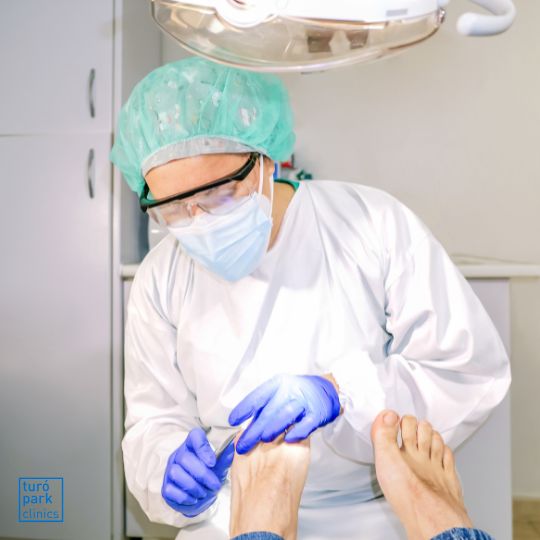
How do we diagnose your condition before surgery?
A successful outcome starts with an accurate diagnosis. Our foot surgery specialists assess not only the symptoms but also the cause of the injury using a comprehensive protocol:
- Medical Consultation: We review your medical history and how the pain affects your daily activities.
- Physical Examination: We assess joint mobility and muscle strength, and identify areas of acute pain.
- Biomechanical Foot Analysis: Depending on the individual case, we carry out a biomechanical analysis of your gait, enabling a more effective surgical approach and a successful post-operative recovery.
- Instant Imaging Tests: We have digital radiography and ultrasound facilities right here at the clinic, allowing us to instantly assess the condition of your bones, tendons and ligaments.
Our techniques: the right solution for every problem
We choose the most effective method based on your condition to ensure you can get back to your routine quickly:
→ Minimally Invasive Surgery (MIS)
Percutaneous surgical techniques that enable the treatment of certain foot deformities, such as hallux valgus (bunions) or claw toes, using small incisions and intraoperative radiological guidance. This approach aims to minimise trauma to the soft tissues and facilitate a more comfortable functional recovery, provided that the condition and the patient’s characteristics make it appropriate.
→ Partial mastectomy
A definitive treatment for ingrown toenails that guarantees a permanent solution to the problem, delivering both functional and aesthetic results.
→ Soft Tissue Microsurgery
Specialising in the removal of cysts, neuromas, warts and pathological calluses, whilst always prioritising the appearance of the skin and the health of the tissue.
Healthy feet are the foundation of a healthy body.
Our podiatrists are on hand to diagnose and treat all your foot and posture problems.
Nail and Soft Tissue Surgery Treatments
Not all foot conditions require bone surgery. In many cases, the cause of pain and functional impairment lies in the nail structures or soft tissues; therefore, treatment must be specifically targeted at these structures in order to achieve an effective and long-lasting result.
Onychocryptosis (ingrown toenail): Partial matricectomy (ingrown toenail surgery)
- Objective: Permanent removal of the nail side and cauterisation of the nail matrix to prevent regrowth.
- Procedure: The affected section of the nail is removed, and a chemical (phenolisation) or physical (laser) technique is applied to destroy the root of that section.
- Duration: 40 minutes
- Post-operative care: Immediate relief. You can return to work within 48–72 hours
Benign soft tissue tumours and papillomas
- Objective: Complete resection of the lesion (synovial cysts, ganglions or lipomas)
- Procedure: A small incision is made over the lesion, the tumour capsule is carefully dissected, and the wound is closed using high-precision cosmetic sutures.
- Duration: 45 to 60 minutes (depending on depth and size)
- Post-operative care: Keep the affected area relatively still during the first week; stitches will be removed after 10–14 days.
We also treat recurrent plantar warts or those resistant to conservative treatments surgically, particularly in cases where topical or chemical therapies have failed to achieve complete resolution of the lesion.
Guide to digital deformities (forefoot)
Deformities of the rearfoot can cause pain, difficulty finding suitable footwear, changes in gait and progressive functional impairment. At Turó Park Clinics, we carry out a personalised biomechanical and radiological assessment to determine the most appropriate surgical technique based on the type of deformity, its stage of progression and the individual needs of each patient.
We treat the deformity using minimally invasive or open surgical techniques, depending on the clinical indication. The aim is to correct the bone misalignment and restore the function of the first metacarpal, minimising tissue trauma and promoting progressive functional recovery. Many procedures allow for immediate ambulation with a functional bandage and specific post-surgical footwear.
We correct foot deformities using procedures involving soft tissues, tendons, joints or bone structures, depending on the stiffness and severity of the deformity. The treatment aims to reduce pain, improve function and make it easier to wear everyday footwear.
We correct painful prominence of the fifth metacarpal using techniques tailored to the extent of the patient’s deformity and symptoms, with a particular focus on reducing mechanical impingement and friction-related pain.
Surgical treatment and interventional management of chronic foot pain
Chronic foot pain can have a significant impact on mobility, sporting activity and quality of life. Before recommending surgical treatment, we carry out a personalised clinical and biomechanical assessment, always prioritising conservative options and less invasive interventional treatments.
In many cases, ultrasound-guided injections and other therapeutic procedures can reduce pain, control inflammation and improve function without the need for immediate surgery. When conservative treatment fails to produce satisfactory results, we consider surgical techniques tailored to the specific condition and functional needs of each patient.
Plantar Fasciitis and Heel Spur
We combine conservative treatments, injections, and minimally invasive surgical procedures for persistent cases of chronic plantar pain. The goal is to reduce tension on the plantar fascia and improve foot functionality.
Haglund’s Deformity
We treat chronic pain and inflammation of the hindfoot associated with the mechanical conflict between the calcaneus, the Achilles tendon, and footwear. Depending on the case, treatment may include injections, regenerative therapies, or surgical correction of the bony prominence.
Morton's Neuroma
Initial management may include footwear modifications, orthotic supports, and therapeutic injections. In refractory cases, we perform surgical decompression or resection of the affected nerve to relieve neuropathic pain and improve functional capacity.
What are the benefits of minimally invasive foot surgery?
Minimally invasive surgery (MIS) of the foot allows certain conditions to be treated using small incisions and specific surgical techniques that minimise damage to soft tissues. However, the suitability of this type of surgery always depends on the condition, the degree of deformity and the clinical characteristics of each patient.
Among its main advantages, in selected cases, the following stand out:
- Less tissue trauma: The percutaneous approach minimises disruption to soft tissues and can lead to a more comfortable post-operative recovery.
- Outpatient procedures in many cases: Many procedures can be carried out without the need for hospital admission, allowing the patient to return home the same day, subject to the doctor’s discretion.
- Local or regional anaesthesia: Many procedures can be performed using distal or regional anaesthetic blocks, thereby avoiding the need for general anaesthesia in certain cases.
- Progressive functional recovery: Depending on the procedure performed, many patients can begin walking early on whilst wearing functional bandages and special post-operative footwear.
- Smaller incisions: Smaller incisions generally result in less visible scars and less damage to the skin compared to conventional open techniques.
The choice between minimally invasive surgery, open surgery or combined techniques should always be made following a specialist assessment, prioritising safety, functional recovery and the clinical objectives of each patient.
Why choose Turó Park Clinics for foot surgery?
We know that the thought of going under the knife can be a little daunting. That’s why we don’t just focus on the medical procedure itself, but also on making sure you feel supported and at ease right from the start.
| Phase | Description | Benefit |
|---|---|---|
| Diagnosis | Comprehensive biomechanical and radiological evaluation. | Absolute precision before taking action. |
| Intervention | Outpatient surgery performed under local anesthesia. | Safe environment, pain-free, and no hospital stay required. |
| Postoperative | Walking out immediately with post-surgical footwear. | Total autonomy from the very first moment. |
| Follow-up | Regular check-ups and personalized wound care. | Full control of your recovery until final discharge. |
Book an appointment with our podiatrist in Barcelona
Frequently Asked Questions about Foot Surgery at Turó Park Clinics
How long is the recovery period and when can I return to my normal activities?
Is it possible to have surgery on both feet at the same time?
Is foot surgery painful?
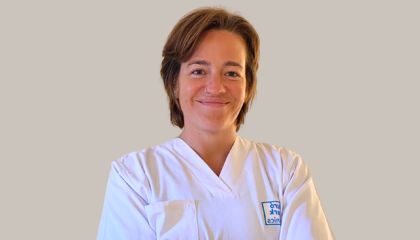
Podiatrist specialized in clinical biomechanics and functional re-education at Turó Park Clinics (Barcelona). With a strong background in minimally invasive foot surgery (MIS) and the design of transition programs to minimalist footwear, she combines daily clinical care with continuous training in sports podiatry and regenerative medicine. Her approach integrates the latest scientific evidence with a patient-centered vision, always seeking effective short- and long-term solutions.
View full profile and credentials →Medical societies and organisations























Take a look at the financing options
Don’t worry, we’ll take care of everything!